Hurricane Isaias:
If you were impacted by the storm, here's
key recovery considerations for the days and weeks ahead
Church Mutual Insurance
Insurance
By Industry
Houses of WorshipNonprofit & Human Services OrganizationsCamps, Sports & Outdoor RecreationEducation & Schools
By Coverage
Specialized CoverageProperty CoverageLiability CoverageWorkers’ Compensation
Resources
Risk Control
View AllChecklists & GuidesSafety ProductsVideos
Articles
View AllCamps, Sports, and Outdoor RecreationEducation and SchoolsHouses of WorshipNonprofit and Human Services
Partner Services
View AllNurse HotlineTelemedicineBackground Checks
Additional Resources
Customer CenterBroker CenterFAQs
Support
Get In Touch
ChatContact Options800-554-2642
Additional Support
Claims CenterPremium AuditPayment CenterFind Your Local RepBroker Center
About
Who We Are
Why Church MutualHistoryLeadershipTestimonialsCM CARES®Newsroom
Careers
Job OpeningsWorking HereCareer AreasDiversity & InclusionBenefitsEarly Career
pay a bill
Pay online:
Make A Payment
Visit our Payment Center for more info. We’ve upgraded our payment system. Read our FAQs for details.
File a Claim
Start Your Claim
Questions? Visit our Claims Center for more info.
Log In
Customer Accounts:
Customer Log In
CREATE ACCOUNT
Broker Accounts:
BROKER LOG IN
CREATE ACCOUNT
search
I’m looking for…
Questions? Check out our FAQs for more info.
Start a Quote
My organization is a
Thank you! Your submission has been received!
Oops! Something went wrong while submitting the form.
Start a Quote
US flagChurch Mutual gives backUS flag
Articles
Camps Sports & Outdoor Recreation
Education & Schools
Houses of Worship
Nonprofit & Human Services Organizations
Severe Weather Preparedness
Articles
Camps Sports & Outdoor Recreation
Education & Schools
Houses of Worship
Nonprofit & Human Services Organizations
Severe Weather Preparedness
6/23/2025
Information

If you need to file a hurricane-related claim, please click here

Recovering after a hurricane

Recovering after a hurricane

After a hurricane passes, you will need a plan to move forward. Church Mutual recommends using the following information to help you communicate with your people, assess the damage and begin the clean-up process.

Communication

Before a hurricane hits, develop a comprehensive communication plan that includes emergency management services. Consider using many different avenues for communication, including:

  • Phone trees.
  • An informative outgoing message on your voicemail.
  • Your website.
  • Social media.
  • Mass notification systems.

Returning to your facility and assessing damage

It’s crucial to determine which of your people should be the first to return to your building. For everyone’s safety, no one should enter the disaster zone alone. Consider those who might be closest to your property and would be physically able to assess the damage. Establish a means for members of this team to communicate with each other.

When returning to your building, remember to:

  • Bring personal protective equipment (PPE), including gloves, eye protection, masks, respirators and sturdy footwear. For more information on PPE, see this catalog from our trusted partner, AEDSuperstore®.
  • Verify your building is structurally sound by looking for color-coded tags from emergency officials, or for signs of serious damage to the roof, exterior walls or foundation. Do not enter the building if there are indications of structural damage, electrical lines are down, or you smell natural gas.
  • Document the damage by taking photographs, videos and notes. Contact your insurance carrier as soon as possible and share your documentation with them.
  • Remain mindful of hazards inside your building that may cause you to trip and fall, as well as mold growth and toxins that may be harmful to your health.
  • Secure your building. Do what you can to make temporary repairs, possibly working with a licensed and insured contractor. If the building is flooded, remove as much of the water as you can so your building can begin drying. If your building’s windows or doors are damaged, use plywood to close off the entry points.

Clean-up

As you plan the clean-up process, you likely will need the help of volunteers. Discover best practices for organizing your volunteers by reviewing Church Mutual’s advice on Volunteer Safety and Management.

The following are a few important reminders:

  • Require all volunteers to sign a release form.
  • Have a well-stocked first aid kit on hand.
  • Remove all drywall and insulation that has been in contact with flood waters.
  • Shut off electricity at the main breaker to the building, even when the power is out.

As you develop your hurricane recovery plan, Church Mutual is here to help. If you have questions or need help getting started, contact Risk Control Central for a no-cost consultation.

Read more about hurricane safety, preparedness and recovery:

  • Hurricane safety and preparedness.
  • Could your facility be a hurricane shelter?
  • Conduct a hurricane tabletop exercise.
  • Last-minute hurricane preparation.

What is your organization doing to prepare for severe weather?

Prepare and protect your organization from nature’s destructive forces by viewing our 10 Essentials of Severe Weather Preparedness. Then take action and step up your severe weather and natural disaster preparedness efforts by using our Severe Weather Preparedness Assessment to see what your organization has covered and discover areas that may need attention.

IMPORTANT: Keeping your organization’s contact information up to date with your insurance provider helps them serve you better, especially if they attempt to contact you before, during or after a weather event.

Additional resources:

  • Your Guide to Severe Weather Preparedness: Protect Your People and Property.

‍

The information contained in these materials is intended solely to provide general guidance on topics that may be of interest to you. While we have made reasonable efforts to present accurate and reliable information, Church Mutual Insurance Company, S.I. and its affiliates disclaim all liability for any errors or omissions or for any actions you take or fail to take based on these materials. The information provided may not apply to your particular facts or circumstances; therefore, you should seek professional advice prior to relying on any information that may be found in these materials.
Share this article with others:
FacebookLinkedinMailLink
URL copied to clipboard!
Explore more risk resources:
By Category
ArticlesChecklists &GuidesSafety ProductsVideos
By Organization
Camps, Sports & Outdoor RecreationEducation & SchoolsHouses of WorshipNonprofit & Human Service Organizations
By Topic
Buildings & GroundsBusiness PlanningCOVID-19 Response & RecoveryCybersecurityFinancial TipsFire Preparedness & PreventionInjury & Illness PreventionMaintenanceSecurity & Crime PreventionSevere Weather PreparednessSexual Abuse PreventionStaff & Volunteer Safety & ManagementTransportation SafetyTravel

Related Risk Management Articles

view all articles
Your Guide to Severe Weather Preparedness: Protect Your People and PropertyYour Guide to Severe Weather Preparedness: Protect Your People and Property

Your Guide to Severe Weather Preparedness: Protect Your People and Property

read the article
Arrow
Could your facility be a hurricane shelter?Could your facility be a hurricane shelter?

Could your facility be a hurricane shelter?

read the article
Arrow
2025 commercial insurance trends2025 commercial insurance trends

2025 commercial insurance trends

read the article
Arrow
Articles
Camps Sports & Outdoor Recreation
Education & Schools
Houses of Worship
Nonprofit & Human Services Organizations
Severe Weather Preparedness

Recovering after a hurricane

After a hurricane passes, you will need a plan to move forward. Church Mutual recommends using the following information to help you communicate with your people, assess the damage and begin the clean-up process.

Communication

Before a hurricane hits, develop a comprehensive communication plan that includes emergency management services. Consider using many different avenues for communication, including:

  • Phone trees.
  • An informative outgoing message on your voicemail.
  • Your website.
  • Social media.
  • Mass notification systems.

Returning to your facility and assessing damage

It’s crucial to determine which of your people should be the first to return to your building. For everyone’s safety, no one should enter the disaster zone alone. Consider those who might be closest to your property and would be physically able to assess the damage. Establish a means for members of this team to communicate with each other.

When returning to your building, remember to:

  • Bring personal protective equipment (PPE), including gloves, eye protection, masks, respirators and sturdy footwear. For more information on PPE, see this catalog from our trusted partner, AEDSuperstore®.
  • Verify your building is structurally sound by looking for color-coded tags from emergency officials, or for signs of serious damage to the roof, exterior walls or foundation. Do not enter the building if there are indications of structural damage, electrical lines are down, or you smell natural gas.
  • Document the damage by taking photographs, videos and notes. Contact your insurance carrier as soon as possible and share your documentation with them.
  • Remain mindful of hazards inside your building that may cause you to trip and fall, as well as mold growth and toxins that may be harmful to your health.
  • Secure your building. Do what you can to make temporary repairs, possibly working with a licensed and insured contractor. If the building is flooded, remove as much of the water as you can so your building can begin drying. If your building’s windows or doors are damaged, use plywood to close off the entry points.

Clean-up

As you plan the clean-up process, you likely will need the help of volunteers. Discover best practices for organizing your volunteers by reviewing Church Mutual’s advice on Volunteer Safety and Management.

The following are a few important reminders:

  • Require all volunteers to sign a release form.
  • Have a well-stocked first aid kit on hand.
  • Remove all drywall and insulation that has been in contact with flood waters.
  • Shut off electricity at the main breaker to the building, even when the power is out.

As you develop your hurricane recovery plan, Church Mutual is here to help. If you have questions or need help getting started, contact Risk Control Central for a no-cost consultation.

Read more about hurricane safety, preparedness and recovery:

  • Hurricane safety and preparedness.
  • Could your facility be a hurricane shelter?
  • Conduct a hurricane tabletop exercise.
  • Last-minute hurricane preparation.

What is your organization doing to prepare for severe weather?

Prepare and protect your organization from nature’s destructive forces by viewing our 10 Essentials of Severe Weather Preparedness. Then take action and step up your severe weather and natural disaster preparedness efforts by using our Severe Weather Preparedness Assessment to see what your organization has covered and discover areas that may need attention.

IMPORTANT: Keeping your organization’s contact information up to date with your insurance provider helps them serve you better, especially if they attempt to contact you before, during or after a weather event.

Additional resources:

  • Your Guide to Severe Weather Preparedness: Protect Your People and Property.

‍

The information contained in these materials is intended solely to provide general guidance on topics that may be of interest to you. While we have made reasonable efforts to present accurate and reliable information, Church Mutual Insurance Company, S.I. and its affiliates disclaim all liability for any errors or omissions or for any actions you take or fail to take based on these materials. The information provided may not apply to your particular facts or circumstances; therefore, you should seek professional advice prior to relying on any information that may be found in these materials.

Related Risk Management Videos

view all videos
Severe Weather PreparednessSevere Weather Preparedness

Severe Weather Preparedness

Watch the Video
Arrow
Articles
Information
Safety Products are NO COST for Church Mutual customers.

Recovering after a hurricane

first-time enrollment
order additional devices
Order In Portal
Recovering after a hurricane

Related Risk Management Safety Products

view all safety products
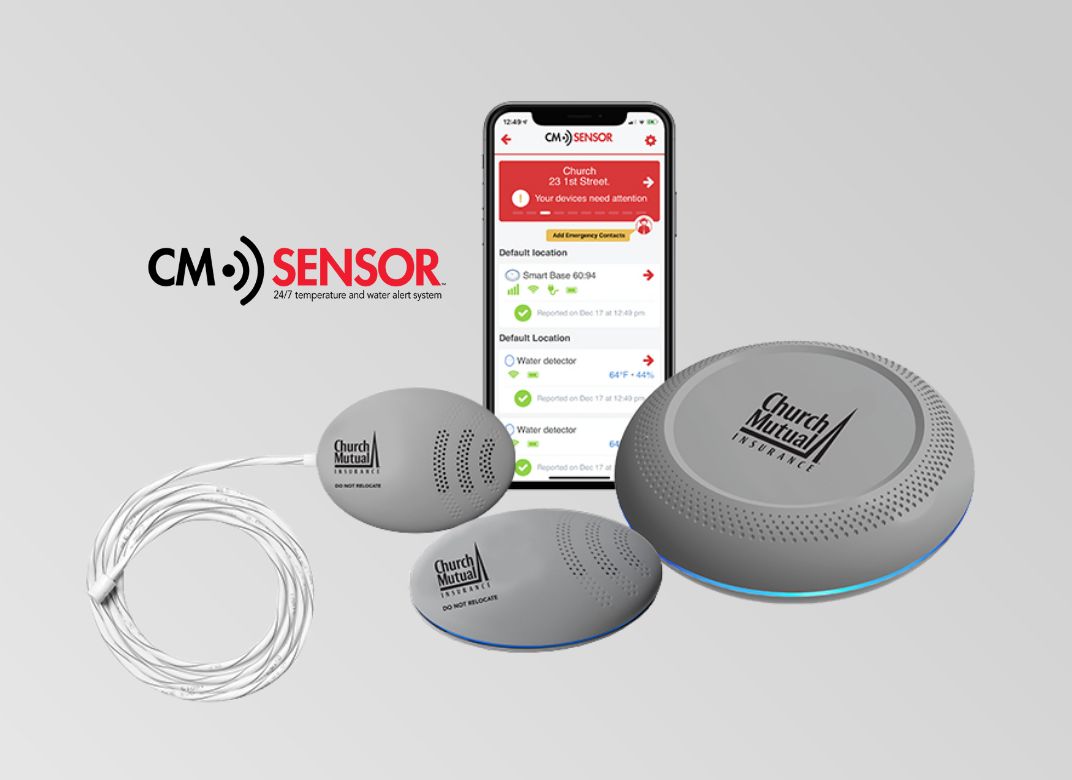
CM Sensor® 24/7 Temperature and Water Alert SystemCM Sensor® 24/7 Temperature and Water Alert System

CM Sensor® 24/7 Temperature and Water Alert System

Learn More & Order
Arrow
CM Wildfire Solutions™CM Wildfire Solutions™

CM Wildfire Solutions™

Learn More & Order
Arrow
Articles
Camps Sports & Outdoor Recreation
Education & Schools
Houses of Worship
Nonprofit & Human Services Organizations
Severe Weather Preparedness

Recovering after a hurricane

download now
open in a new tab
Recovering after a hurricane

After a hurricane passes, you will need a plan to move forward. Church Mutual recommends using the following information to help you communicate with your people, assess the damage and begin the clean-up process.

Communication

Before a hurricane hits, develop a comprehensive communication plan that includes emergency management services. Consider using many different avenues for communication, including:

  • Phone trees.
  • An informative outgoing message on your voicemail.
  • Your website.
  • Social media.
  • Mass notification systems.

Returning to your facility and assessing damage

It’s crucial to determine which of your people should be the first to return to your building. For everyone’s safety, no one should enter the disaster zone alone. Consider those who might be closest to your property and would be physically able to assess the damage. Establish a means for members of this team to communicate with each other.

When returning to your building, remember to:

  • Bring personal protective equipment (PPE), including gloves, eye protection, masks, respirators and sturdy footwear. For more information on PPE, see this catalog from our trusted partner, AEDSuperstore®.
  • Verify your building is structurally sound by looking for color-coded tags from emergency officials, or for signs of serious damage to the roof, exterior walls or foundation. Do not enter the building if there are indications of structural damage, electrical lines are down, or you smell natural gas.
  • Document the damage by taking photographs, videos and notes. Contact your insurance carrier as soon as possible and share your documentation with them.
  • Remain mindful of hazards inside your building that may cause you to trip and fall, as well as mold growth and toxins that may be harmful to your health.
  • Secure your building. Do what you can to make temporary repairs, possibly working with a licensed and insured contractor. If the building is flooded, remove as much of the water as you can so your building can begin drying. If your building’s windows or doors are damaged, use plywood to close off the entry points.

Clean-up

As you plan the clean-up process, you likely will need the help of volunteers. Discover best practices for organizing your volunteers by reviewing Church Mutual’s advice on Volunteer Safety and Management.

The following are a few important reminders:

  • Require all volunteers to sign a release form.
  • Have a well-stocked first aid kit on hand.
  • Remove all drywall and insulation that has been in contact with flood waters.
  • Shut off electricity at the main breaker to the building, even when the power is out.

As you develop your hurricane recovery plan, Church Mutual is here to help. If you have questions or need help getting started, contact Risk Control Central for a no-cost consultation.

Read more about hurricane safety, preparedness and recovery:

  • Hurricane safety and preparedness.
  • Could your facility be a hurricane shelter?
  • Conduct a hurricane tabletop exercise.
  • Last-minute hurricane preparation.

What is your organization doing to prepare for severe weather?

Prepare and protect your organization from nature’s destructive forces by viewing our 10 Essentials of Severe Weather Preparedness. Then take action and step up your severe weather and natural disaster preparedness efforts by using our Severe Weather Preparedness Assessment to see what your organization has covered and discover areas that may need attention.

IMPORTANT: Keeping your organization’s contact information up to date with your insurance provider helps them serve you better, especially if they attempt to contact you before, during or after a weather event.

Additional resources:

  • Your Guide to Severe Weather Preparedness: Protect Your People and Property.

‍

The information contained in these materials is intended solely to provide general guidance on topics that may be of interest to you. While we have made reasonable efforts to present accurate and reliable information, Church Mutual Insurance Company, S.I. and its affiliates disclaim all liability for any errors or omissions or for any actions you take or fail to take based on these materials. The information provided may not apply to your particular facts or circumstances; therefore, you should seek professional advice prior to relying on any information that may be found in these materials.
download now
open in a new tab

Related Risk Management Checklists & Guides

view all checklists & guides
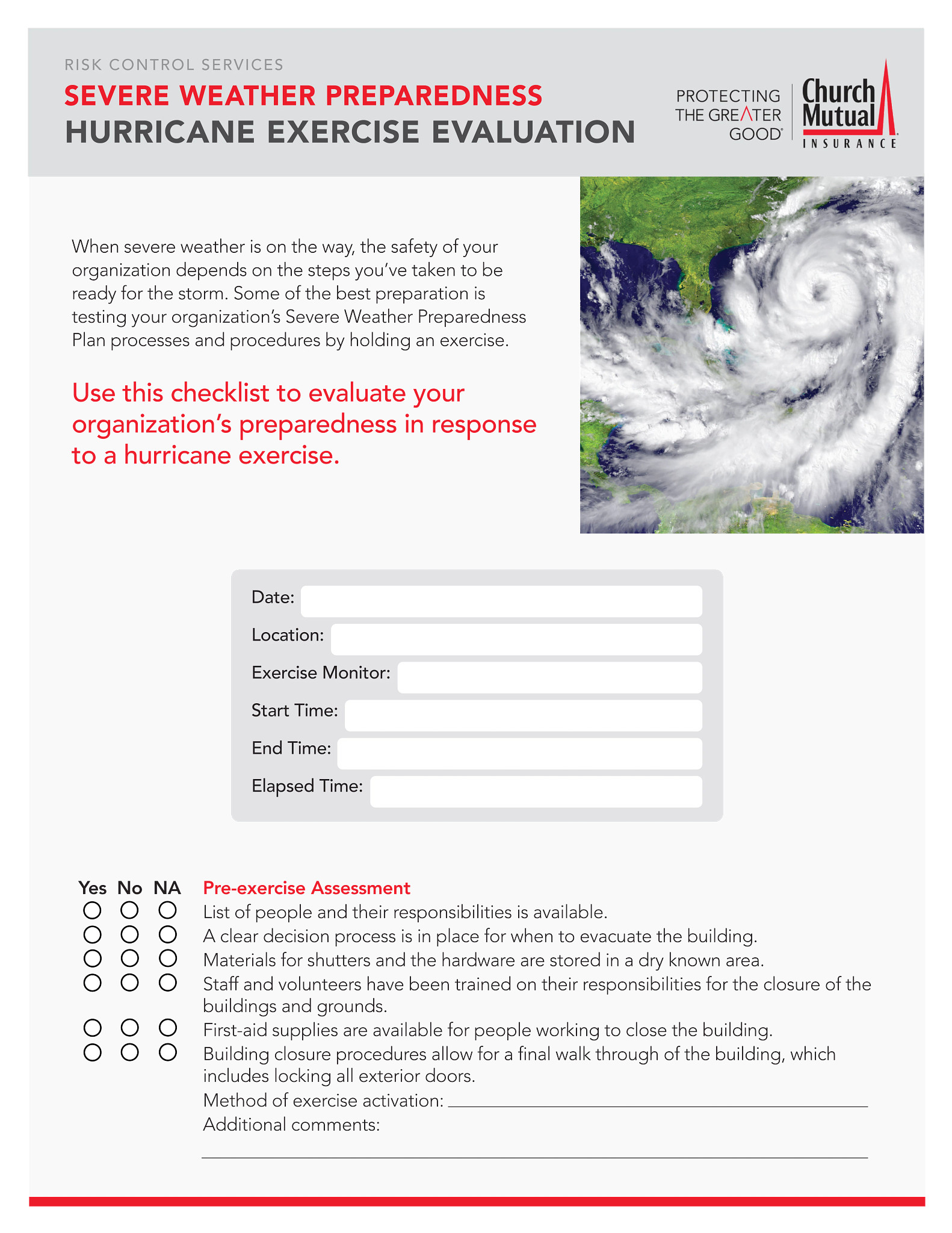
Test Your Readiness: Hurricane Exercise Evaluation GuideRecovering after a hurricane

Test Your Readiness: Hurricane Exercise Evaluation Guide

Get the Guide
Arrow
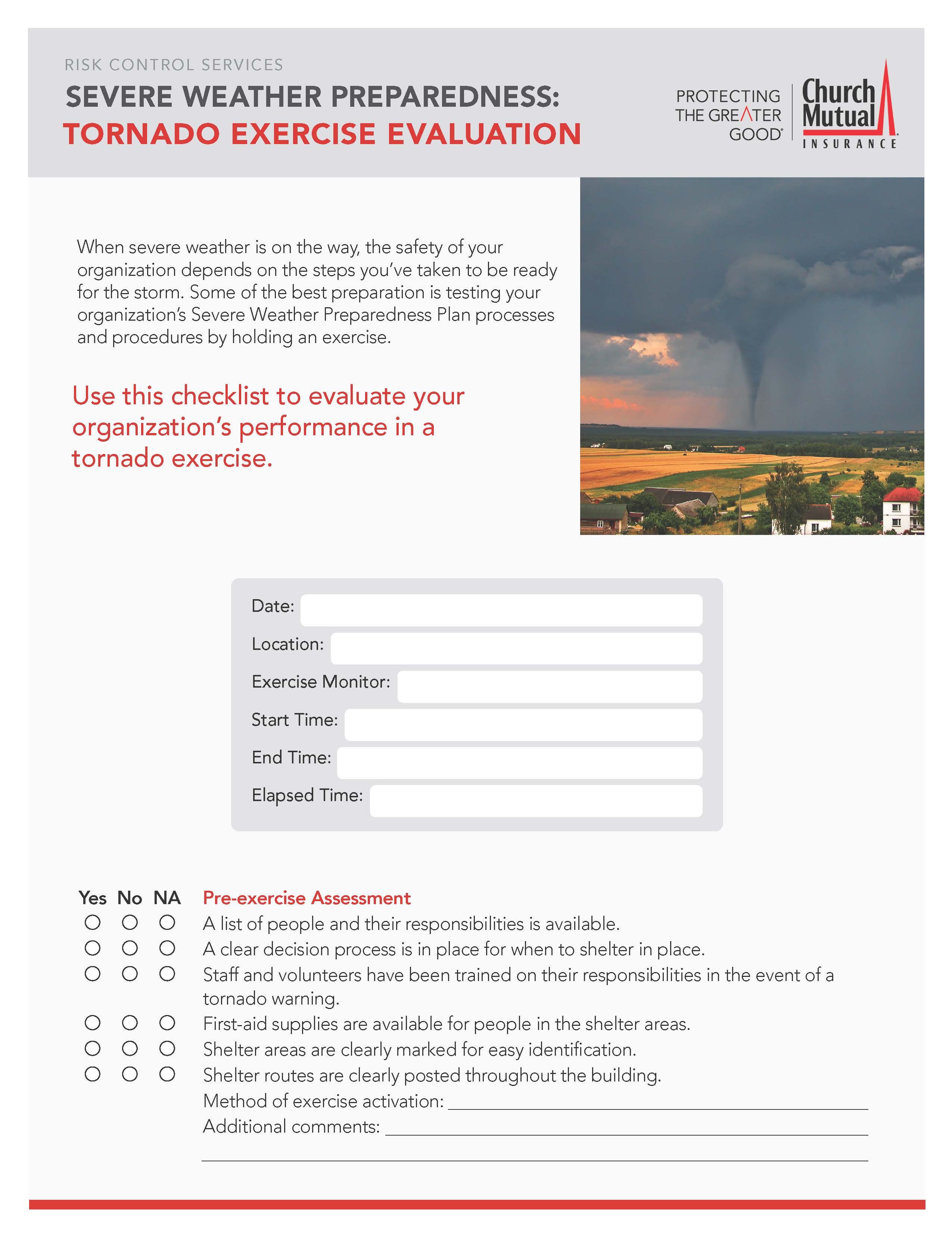
Tornado Exercise Evaluation: Test Your PreparednessRecovering after a hurricane

Tornado Exercise Evaluation: Test Your Preparedness

Get the Guide
Arrow
Take Precautions Against Lightning With Protection SystemsRecovering after a hurricane

Take Precautions Against Lightning With Protection Systems

Get the Guide
Arrow
Church Mutual Insurance
Facebook
LinkedIn
Youtube
Instagram
800-554-2642
Quick Links
Request a QuotePay a BillFile a ClaimFind Your Local Rep
Get Answers
Contact UsClaims CenterPayment CenterCustomer CenterBroker CenterNewsroom
Careers
Job OpeningsWorking HereCareer AreasDiversity & InclusionBenefitsEarly Career
Site Map
|
Consent Preferences
|
Legal & Privacy Policy

Church Mutual Insurance Company, S.I. (a stock insurer) | P.O. Box 357 | 3000 Schuster Lane | Merrill, WI 54452-0357 | Telephone (800) 554-2642 or (715) 536-5577
© 2026 Church Mutual Insurance Company, S.I. All rights reserved. Protecting the Greater Good is a registered trademark of Church Mutual Insurance Company, S.I.

¹ Church Mutual is a stock insurer whose policyholders are members of the parent mutual holding company formed on 1/1/20. S.I. = a stock insurer.